 Slovenski INSPIRE metapodatkovni sistem
Keyword
National
53 record(s)
Type of resources
Categories
INSPIRE themes
Keywords
Contact for the resource
Formats
Representation types
Scale
Resolution
-
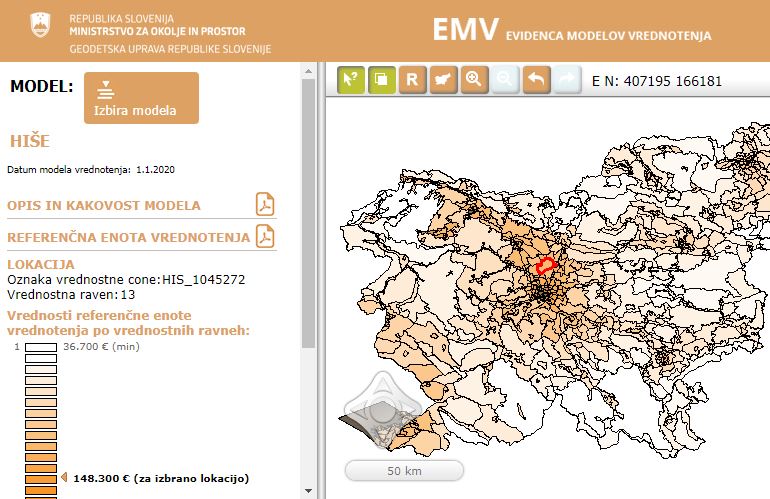
Real Estate Valuation Models Database is a public database of real estate valuation models. The valuation model defines the impact of different real estate characteristics on a market value of the real estate.
-
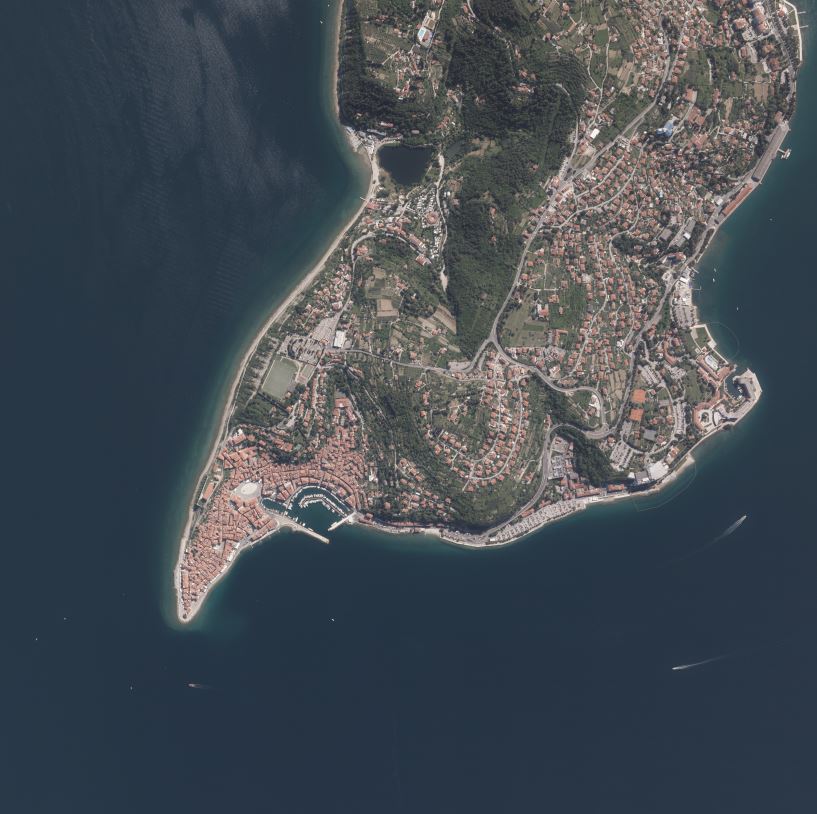
Product of aerial survey (from airplane, helicopter) are aerial images as well as external orientation elements, that are used as final product or as an input parameter for further image processing. In the cyclical aerial survey of Slovenia professional (recently digital, large format) aerial cameras are used. These cameras use simultaneous surveying of aerial photos in several channels (panchromatic, red, green, blue, near infrared). Usuall ground sampling distance (GSD) is 0.25 m.
-
The EuroBoundaryMap collection for Slovenia is part of the European collection at 1 : 100 000 scale, which homogenously covers 55 countries.
-
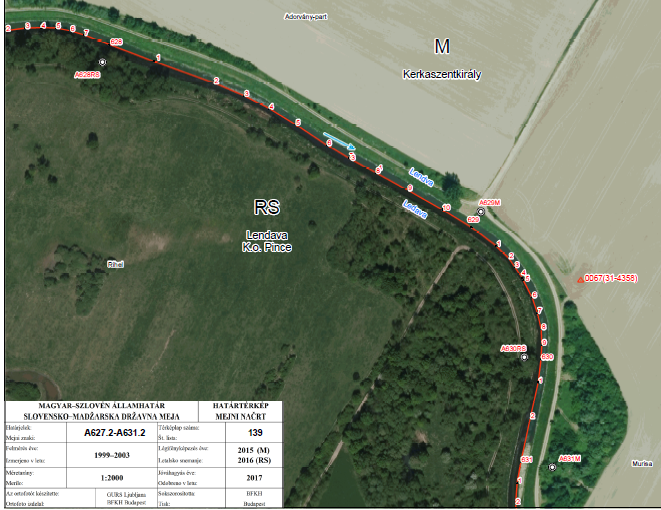
Database contains attributes about border points of a national border. These points are marked (physically on the field - border markers) and unmarked (breaking points). Border points indicate the national border of the Republic of Slovenia. Coordinates are defined in the coordinate system D48, Gauß-Krügerjev projection. National Border Record is the fundamental register of the national border points. It contains data about country code, sector, type and position of the border mark, its label, coordinates in the D48/GK and D96/TM coordinate system and the neighbouring country reference system, the possible distance from the border line and the distance to the next border mark. National Border Record is established based on the Real Estate Cadastre Act - ZKN (Official Journal of RS, No. 54/2021). Data from the National Border Record serves as a graphical representation of the national border, for the harmonization of Land Cadastre data and the Administrative Units Register with the national border.
-
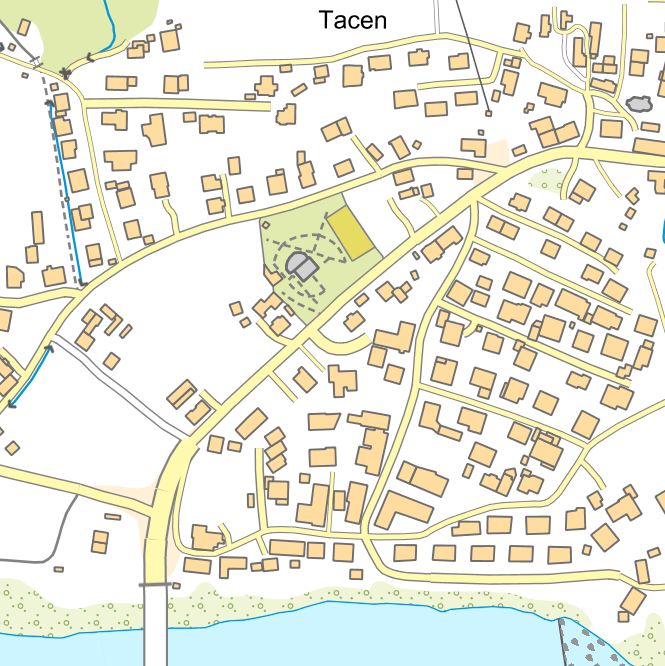
The collection of topographic data is maintained in the form of the National Topographic Model (DTM), which contains graphical and attribute-based topographic data on features that correspond to the accuracy of the 1:5,000 scale. The DTM includes topographic data for the territory of Slovenia in compliance with INSPIRE guidelines. The DTM also comprises geographical names and a digital terrain model. DTM data can be used for geolocating other spatial data, as a base for the display of graphical components of municipal spatial planning documents, and for the purposes of digital cartography. The data can also be linked to datasets from various administrative sectors.
-
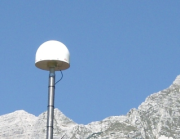
Two national CORS networks have been established in Slovenia, i.e.: - the SIGNAL Network (the abbreviation means: SlovenIa-Geodesy-NAvigation-Location) and - the Zero-Order Combined Geodetic Network. The SIGNAL Network provides data and services for the positioning in the national coordinate and height reference systems (CRS, HRS). The Zero-Order Combined Geodetic Network enables quality control of the SIGNAL Network data and services as well as the realization of the national spatial reference system (SRS) and monitoring of its quality in long term. The data provided by the national CORS networks contain GNSS observations at the permanent GNSS stations and their corrections generated by processing the data from the whole network. These data are needed for the positioning in the national CRS/HRS by applying: - kinematic GNSS positioning in real time (RTK) or - static or fast static GNSS positioning with processing of the collected observations in the office (post-processing). The data for the real-time positioning are available in the RTCM format via web connection (NTRIP protocol) or via dial-up acces (GSM) as: - RTK services for the positioning based on phase observations ( few cm accuracy) and - DGPS services for the positioning based on code observations (few dm accuracy). The GNSS observations collected for the post-processing are available in RINEX (Receiver Independent Exchange) format as: - RINEX files for the CORS network stations or - virtual RINEX files for the selected location. RINEX data can be accessed via the RINEX Portal of the Service for the GNSS. They can be ordered for a set of CORS network stations or selected locations of GNSS surveys, for the required time span and interval of registration of the GNSS signals.
-
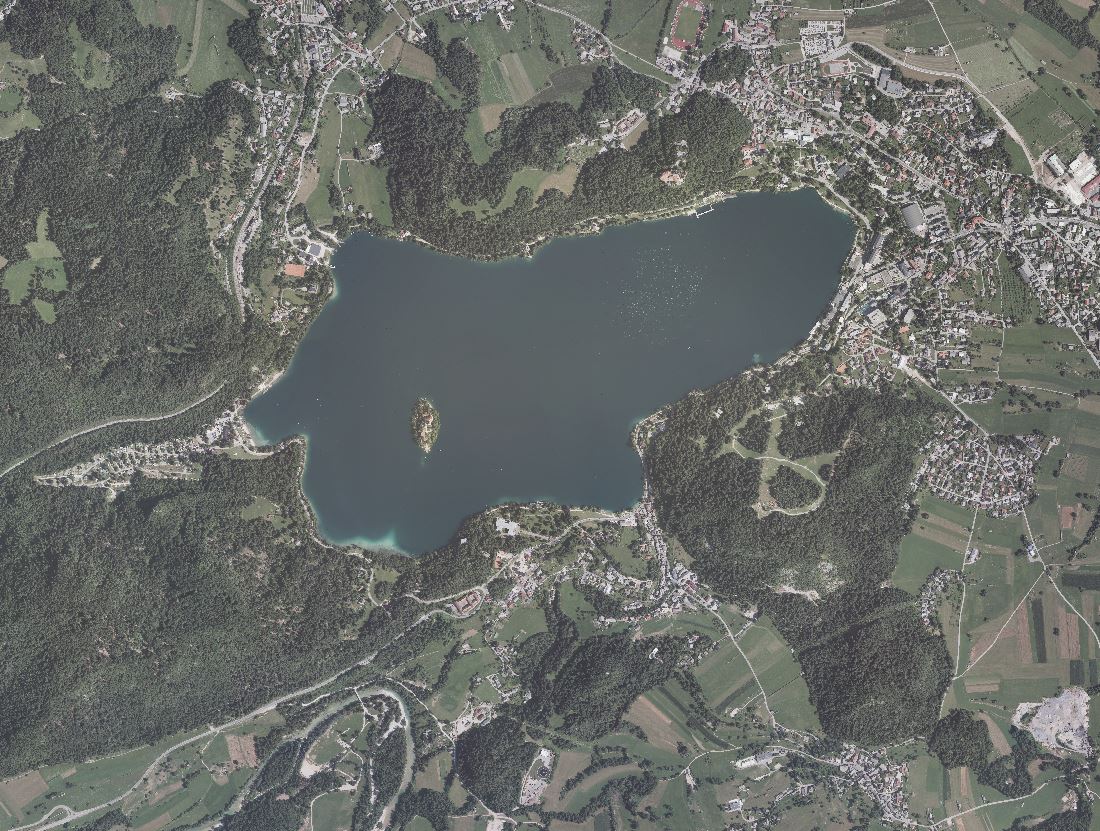
An orthophoto is an aerial photograph that has been transformed from a central to an orthogonal projection by taking into account terrain relief data and the absolute orientation of the aerial photographs. In this process, the effects of the camera optics, camera tilt, and terrain undulation are removed. Orthophotos are metrically comparable to line maps, and their sheet division corresponds to that of TTN5. All orthophotos are available in TIFF format. Different orthophotos are produced according to spatial resolution and colour spectrum: DOF025 – colour (RGB) orthophoto with a ground sampling distance (GSD) of 0.25 m DOF050 – colour (RGB) orthophoto with a ground sampling distance (GSD) of 0.50 m DOF050IR – colour near-infrared orthophoto (IR, R and G) with a ground sampling distance (GSD) of 0.50 m
-
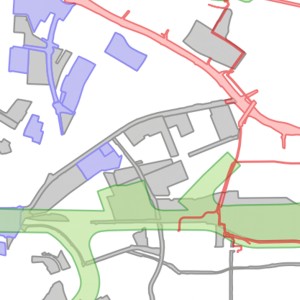
Geographical areas of spatial plans from completed procedures include: - areas of national spatial plans, - areas of regional spatial plans, - areas of local spatial plans. Geographical areas of spatial plans are part of database of spatial plans.
-

The Real Estate Market Record is a multi-purpose, public database on concluded sales and rental real estate transactions. It is managed and maintained by the Office for Mass Real Estate Valuation at the Surveying and Mapping Authority of the Republic of Slovenia. The database was established at the beginning of 2007. In the same year, public access to the recorded data was also enabled, and the Surveying and Mapping Authority of the Republic of Slovenia started publishing reports on the Slovenian real estate market.
-
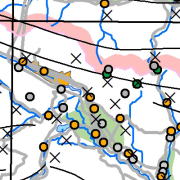
Vector data collection DPK 750V is an object-oriented cartographic database at 1 : 750 000 scale. Elements on the map are divided into eight object groups: mathematical elements, settlements and objects, communications, relief, hydrography, land cover, boundaries and dividing line, geographical names. The data set is used for "rough" geo-orientation and for the needs of large scale and thematic displaying.